-
Stephen Cottrell – Dear England
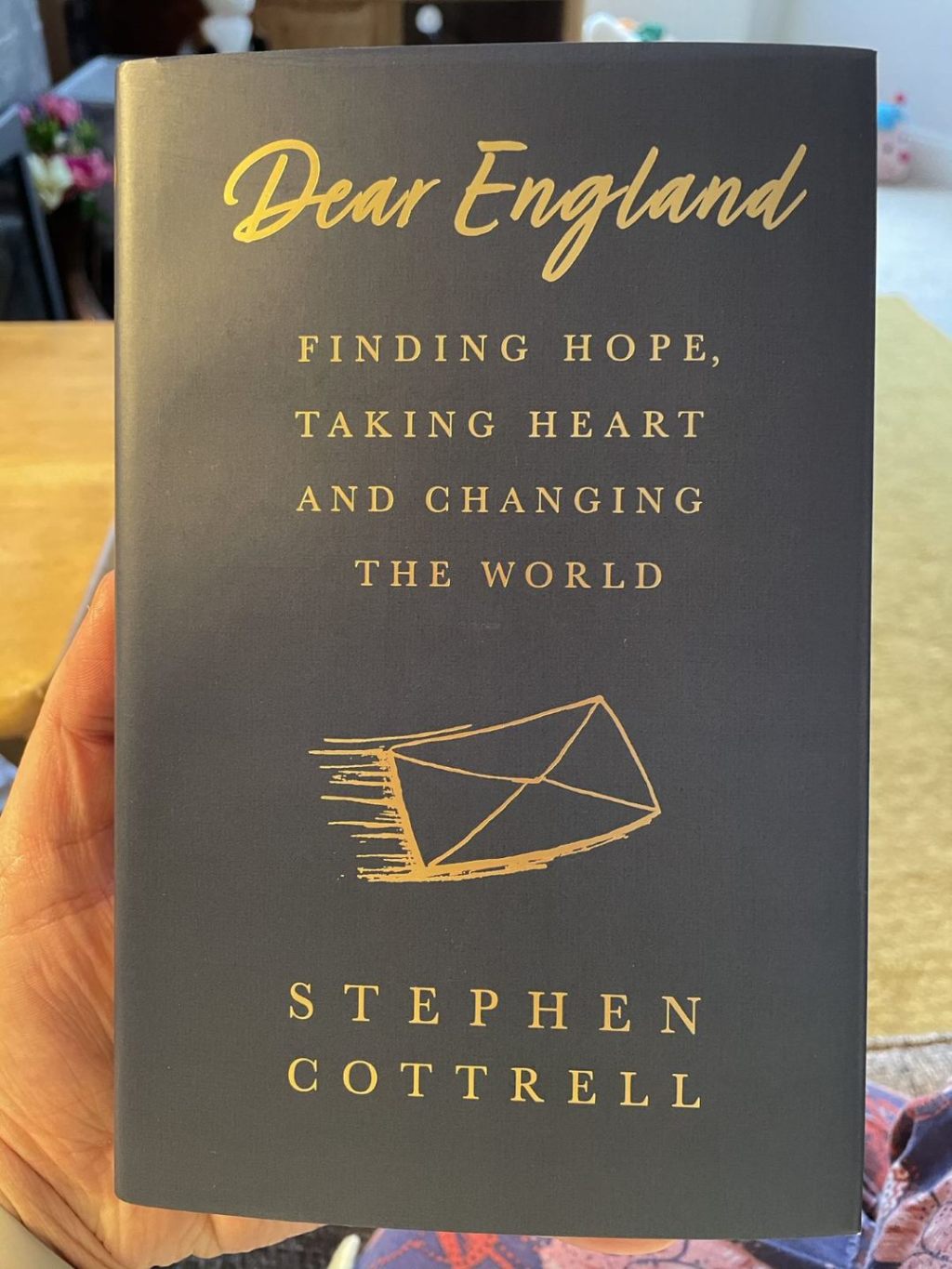
The author introduces this book by recounting a story of a conversation he had in Paddington Station (Caffe Nero to be precise), when the barista asked him what sounds like an innocuous question: “What made you become a priest?”.
Obviously when buying a coffee in a busy train station, there’s not much time to answer such a question as that, but this book is the response that he would have made if he’d had the time (a lot of time…).
If you didn’t know, the author Stephen Cottrell is the new Archbishop of York. I’ve never read any of his writing before, but this book came highly recommended on Twitter and I really wanted to know his answer to the question.
What followed the introduction is a letter to the people of England that was approachable and easy to read, but at the same time, packed a huge punch in terms of theological content and bits that made me have to re-read them again then note them down for later because they were so insightful.
I really liked the fact that it wasn’t heavy on the use of Bible verses. It mentioned them without quoting them extensively and I think that will help hugely with making this book more approachable for non-Christians. I’ve read a fair few books in the past that have quoted way too much and it can be off-putting for someone who has never even opened a Bible before.
As I mentioned, I highlighted many quotes while reading this book, but some of my favourites were when the author was talking about love.
“We know that there isn’t a limited supply of love. You can give it all away completely and still have every bit of it left to give again … Love replenishes itself by being given away”
And in particular how free will interacts with God’s love for us.
“For it to be love it has to be free… so God makes the world with all its terrible beautiful freedom, because that is the only way for it to be love.”
The book touches on topics like LGBTQ+, Black Lives Matter, Brexit and Coronavirus, giving it a very timely feel and challenging the reader to be part of the change for good, while affirming that God loves us all equally.
” Unity is not uniformity, difference is not a threat .”
I would recommend this book to anyone, to non-Christians who want to read a detailed but understandable reasoning for the Christian faith, and for Christians who want to be inspired by the author’s example to perhaps share a bit more of their faith, and catch on to his passion for wanting to change the world for the better.
-
Tim Hughes & Nick Drake – Why Worship?
I was given this book on NetGalley in exchange for a review.
I’ve been following Tim Hughes’ music since I bought one of his CDs in a Wesley Owen shop (remember them?) in Leeds in 2003, and when I saw this book start to be mentioned on Twitter, I knew I needed to read it – seeing it on NetGalley just sealed the deal for me.
The book is split into 4 parts:
- Who and why we worship
- Where and how we worship
- What happens when we worship?
- The Future
Each section is split into multiple chapters, each written by a different contributor, including Graham Kendrick and Lou Fellingham. I loved this as it means you get a different (and expert) perspective and you see each contributor’s passion for their subject shine from the pages.
I don’t know about other people, but usually when I hear the word worship, I immediately think about singing and music. This book cracks that open and explores how worship means so much more, it’s how we live our lives in pursuit of relationship with God.
“Worship is about the mess and fragility of humanity being caught up in the perfection and love of divinity.”
Similarly, when I think of worship, I often think of positivity, and how worship can feel like a struggle when you’re going through a hard time. When singing praise just doesn’t feel right because of the time you find yourself in. But as the book says:
“When we worship, we can be filled with joy no matter what our circumstances are. We can find reason to hope even when all around us seems bleak.”
This has become more and more apparent over the last year when bleakness has been a dominating emotion, with fear, sadness and isolation taking over.
Even when it doesn’t change our circumstances, praise often changes our perspective.
Filled with biblical references, my particular favourite chapters were the three at the start which discussed separately how we worship the Father, Son and Holy Spirit, so much more in depth than I’ve ever gone before.
This book is apparently the Spring Harvest 2021 theme book, and I’m really glad that it will be read more widely as I think there’s a lot to take from it.
The NetGalley copy I have will disappear in a few days and I’m sad about that because I think this book is the kind that will deliver new insights each time you read it, so I’m definitely going to have to find myself a paper copy to dive back into.
-
Dr Joshua Wolrich – Food Isn’t Medicine

“Would you rather be healthy and fat or unhealthy and thin?”
Wolrich poses that the fact that you hesitate when you’re faced with that question is part of the problem which has lead to such huge problems of weight stigma in the western world. Fat is somehow seen as a problem not just a descriptive word, no matter the health. And thin is hailed as the goal no matter what.
In the first part of the book, Wolrich debunks some of the common arguments for this stigma, including an enlightening history of the BMI scale. This section really made me think about my relationship with my body and how I talk to myself. It’s so easy to internalise what society tells you without thinking about it and we don’t deserve to do that to ourselves.
The second part of the book then turns to debunking some common myths about food, what Wolrich calls ‘Nutribollocks’ – my new favourite word.
He talks in detail about how people praise this or that food and claim it can heal you from certain illnesses because of the nutrients they have in them. But as Wolrich says, we eat food not nutrition. Just because a food has a nutrient in it doesn’t mean it has those properties. Monster drinks have a chemical in that can help with PCOS, but that doesn’t mean monster is prescribed as a cure and you would never think it did, so why do we (as a society) fall for this with so called ‘healthy’ foods and miracle cures.
Food is not medicine.
I’ve been following Dr Wolrich on Instagram for a long while now, and he’s such a recommended follow, calling out posts for being misleading or just downright lying, and bringing a voice of reason into a field of shouting buffoons.
The audiobook that I listened to (thanks to NetGalley) was narrated by the author and I was so glad for this, he has such an easy voice to listen to, presenting everything clearly and in a really straightforward manner, which must have been difficult given the nature of the book and some of the more complex topics being discussed.
I was given this book from NetGalley in exchange for a review, but I’ll be heading straight out to buy a copy of this as I think it’s so important.
-
Robert Jordan – The Eye of the World
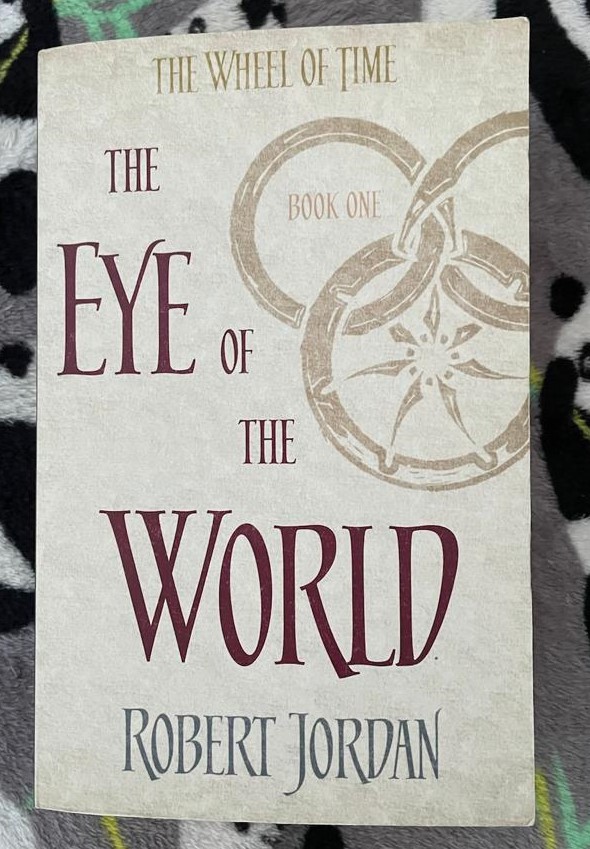
So…I started reading this book in January…2019. I made it around 100 pages in, but it felt like a struggle and I just couldn’t find that compulsion to keep reading. With 700 pages left to go, I simply gave up.
But I hate leaving books half finished, so I finally came back to it again two weeks ago (and 2 years after starting). It turns out that the point I gave up the book was just on the cusp of it getting really exciting. I’d plodded through a lot of the initial setup and given up just before it got going.
The book starts in the village of Emonds Field, and we meet our main character Rand. We spend quite a lot of time in the village meeting our band of supporting characters, and it seems like we may never leave…
But then Rand, Mat, Perrin, Egwene, Nynaeve, Moraine and Lan have to leave Emonds field in a hurry, they need to get to Tar Valon. Moraine is very cryptic about why the three boys are so necessary to defeating the darkness, just that they are in ‘the pattern’, and part of what the wheel weaves.
Once the band were on their way, I got very tolkien-esque vibes from the book – a group of people all setting out to defeat evil on a long and winding quest. I didn’t mind that so much though, I love LOTR and it didn’t feel like a copy to me, just a similar style.
My favourite part of the book (I don’t know if this is mean or not) was when the characters all became separated. I felt like the pace of the book increased and because we were splitting perspective between the different groups, we got to know each of the characters more in depth and it really helped to build a connection.
I also loved how (unlike a lot of epic fantasy books), the women weren’t just supporting characters. They had a lot of the power and ruling and that felt a bit unusual to me, although the tides are definitely turning in more recent fantasy books.
I don’t want to talk about the plot too much because it would be too easy to give away major spoilers (I’ve probably already said too much), but what I will say is that I found the ending of the book fairly anti-climactic. It felt like the peril was building up and up and up and then I realised there weren’t many pages left in the book so I assumed it must spill over into the next one, but no.
The final scenes all felt a bit rushed to me after such a build up and that was a bit disappointing, but it did finish in such a way that I really want to read the next book in the series now – I’m just hoping the pace of the second book picks up now that the world-building has been established and we’re familiar with the characters.
-
Rachel Morgan – The Memory Thief

I downloaded this book at the beginning of the year when apple books were giving away a lot of free audio-books, and I didn’t really know what to expect. I hadn’t read any blurbs or anything, just that it was a cinderella re-telling.
I was a bit surprised when I realised it was Fae and Vampires, but this was one of my favourite genres about ten years ago, so I was excited to give it a go.
Elle is a human girl, bound to her stepmother as a slave, and there is only one way she can escape. She needs to get enough ‘essence’ to purchase a wish, a top-tier wish, so she can ask the Godmother to free her from her slavery.
Thankfully, Elle has a special talent that her family don’t know about, she’s able to take people’s memories from them. And she has a steady trade of clients that she meets with who would rather forget certain things, and will pay her in essence to make those memories go away.
But one night at a club while she’s doing a job, she finds herself wound up with vampires, and they definitely do not have good intentions for her. When she finds herself kidnapped, her worry is getting back home before midnight so her stepmother doesn’t find out that she’s been out, but she should perhaps have bigger worries.
I was kind of disappointed to realise when the audiobook finished that this is actually part 1 of the City of Wishes novel, and it left the story incredibly unfinished. I’d love to know how this ends (although I think I can probably make a good guess), but I don’t know if I was so enthused about the story that I’d pay to finish reading it (sorry!), especially since each part is only a smidge over 100 pages.
I did enjoy Elle’s character though, and the narration was good too – the air-headed voices of Elle’s stepsisters reminded me of the Paris Hilton impression done by GottMik on Ru Paul’s Drag Race, and that made me smile – I love it when the narrator is so good that you lose yourself in the story.
-
Anne Lamott – Dusk, Night, Dawn
I had a copy of this book as an ARC from NetGalley, the cover drew me right in, and the blurb seemed like it could be a very well timed book for me:
” How do we get through dark times when we feel like giving in to fear and despair, and when existential dread has convinced us of our smallness? “
Unfortunately, the style of the book was not my cup of tea. It was written kind of like a stream of consciousness, and I found that the author changed the subject what seemed like quite randomly at times. I found it quite hard to follow and even harder to find a connection to the book to keep me enthused to keep reading.
I think this is a reflection on me, not the book though. I can definitely see how for some people this would be a lovely book with a lot of insight to bring.
Part memoir and reflection on life following her recent marriage, and part a lesson on hope and restoration in turbulent times, the author had many good points that I saved as quotes into my notes as I was reading.
The author talks a lot about her experiences in Sunday school which I could definitely relate to, and I loved this quote:
“If you want to help kids fall in love with God, help them fall in love with nature”
For me though, I don’t feel like the book quite lived up to what I was expecting from the blurb. I was expecting to come away with some techniques for coping with dark times, but I think because of my lack of connection to the book I just didn’t get that.
I’m giving this book 3 stars because I can see how it could be the perfect book for other people, but it just wasn’t for me unfortunately.
224 pages. Published in: 2021Read in E-bookon 23rd February-3rd April 2021 -
Laura Jane Williams – The Love Square
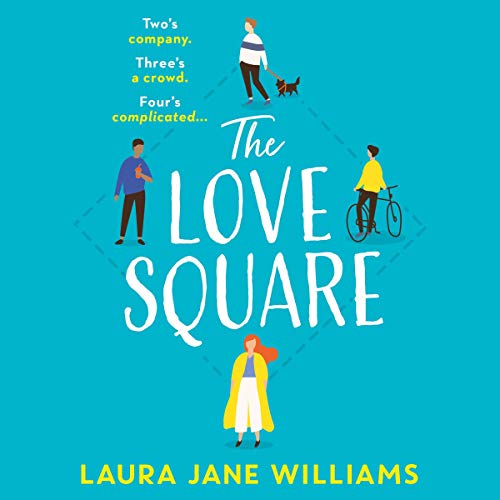
I’m not going to lie, I only really bought this book because it’s narrated by Carrie Hope Fletcher, who I really love. She has such an emotive voice and a way of bringing stories to life, so I would probably buy any book that she narrates (there’s nothing worse than a great story ruined by a poor narration).
It took a while for this book to warm up for me, it felt like I’d been listening quite a while before I felt the momentum pick up, but I am glad I persevered because I thought the book was good.
Penny Bridge has been through a lot in life, but it seems like life is finally going well. All that is, except her love life. Penny wants to have a baby, but there’s no-one on the horizon. That is until Francesco shows up and they fall hard quickly. It feels like everything is perfect, until life turns upside down for Penny and things with them end on a wrong note.
After this, Penny falls for another man, and then another. And then Francesco appears back on the scene. What will Penny do?
I thought the story was fun and light-hearted (although with deeper parts to the storyline too), but I didn’t feel an emotional connection to Penny, probably because I didn’t really agree with the choices she was making. It felt like she was just toying around and given that I wouldn’t appreciate that if it was coming from a man, I didn’t like it here either. I don’t know if it was supposed to be a take on female empowerment, but it wasn’t for me really.
What I did like was the diversity of characters in the book and the fact that it didn’t feel forced, and the friend/sister relationships that Penny has are perfect – if anything they should be the highlight of this story, not the men.
I have another book by this author on my shelf (paperback rather than audio this time) and I’m looking forward to picking that up, I liked the author’s style and I’m interested to see what it’s like.
-
David Robertson – What Would Jesus Post?

I started reading this book before lockdown 1.0 last year and unfortunately it just wasn’t the right time for me to be reading it, so I’ve only just got round to finishing it – not a reflection of the book, just a crazy year!
Focusing on how to remain true to your Christian self while interacting online, this book was so interesting. With topics like wisdom and discernment and sewing a digital seed, it covered a wide range of topics.
I think my favourite one was about digital sabbath. This may look different for everyone, but I’d never really thought about doing it. Obviously I know that taking a screen break is a good idea, but practising it as a sabbath and being intentional about what I replace that time with is such an interesting idea.
Each chapter contains a description of the way things are, a section that goes a bit deeper, then a bit about how to go forward. Each then finishes with a biblical perspective, wisdom from the Psalms and some questions designed to make you think (or to be used in a group discussion).
It’s definitely made me think a bit more about how some of my online interactions may not be ideal and how I could do better. At only 150 pages, it was a nice short book full of punchy truths.
May these words of my mouth and this meditation of my heart be pleasing in your sight, Lord, my Rock and my Redeemer.
Psalm 19:14 -
Frank Herbert – Dune
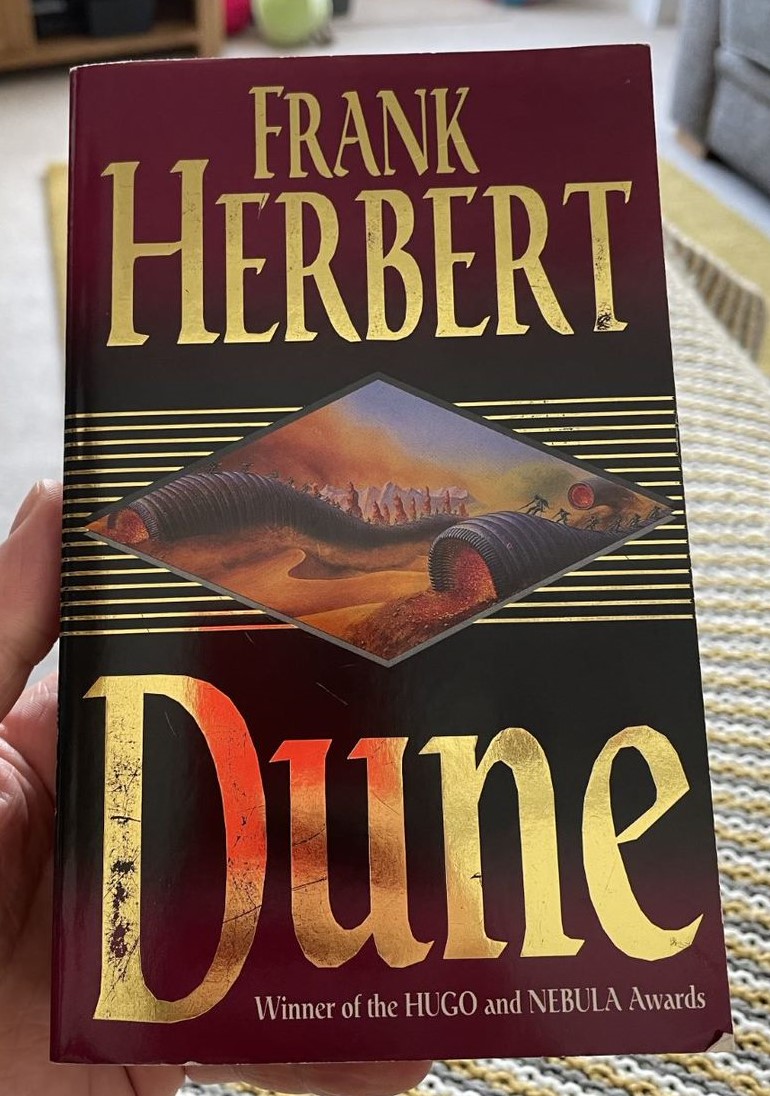
I wanted to love this book so so much. It was one of my Dad’s favourite books, and I was even reading his copy. To be holding and reading a book I knew he loved so much made me long to love it too.
But I don’t know if it was just bad timing for me to read it, because I just couldn’t get ‘into’ the book. I didn’t feel connected and I couldn’t keep track of what was happening in my head.
I started reading it a couple of years ago and ended up almost abandoning it, but I just finished the last 3rd over the last week and it felt like a different experience. All of a sudden the pace felt faster and the action felt more exciting and I was gripped in a way that I just wasn’t before.
I’m disappointed in myself to be honest that I didn’t feel that connection in the start, but I think what I might need to do is read it again in future when my head is perhaps in a different place. I think the loss of my dad was too raw when I first started and I put too much pressure on myself.
I have the rest of the Dune series on my shelf (also my dad’s copies), so I will definitely come back to this in future and see if I can love it anymore than I did this time. I don’t really even want to do a ‘proper’ review of it now because I don’t think it’s fair to not do the book justice.
-
Richard Roper – Something to Live For
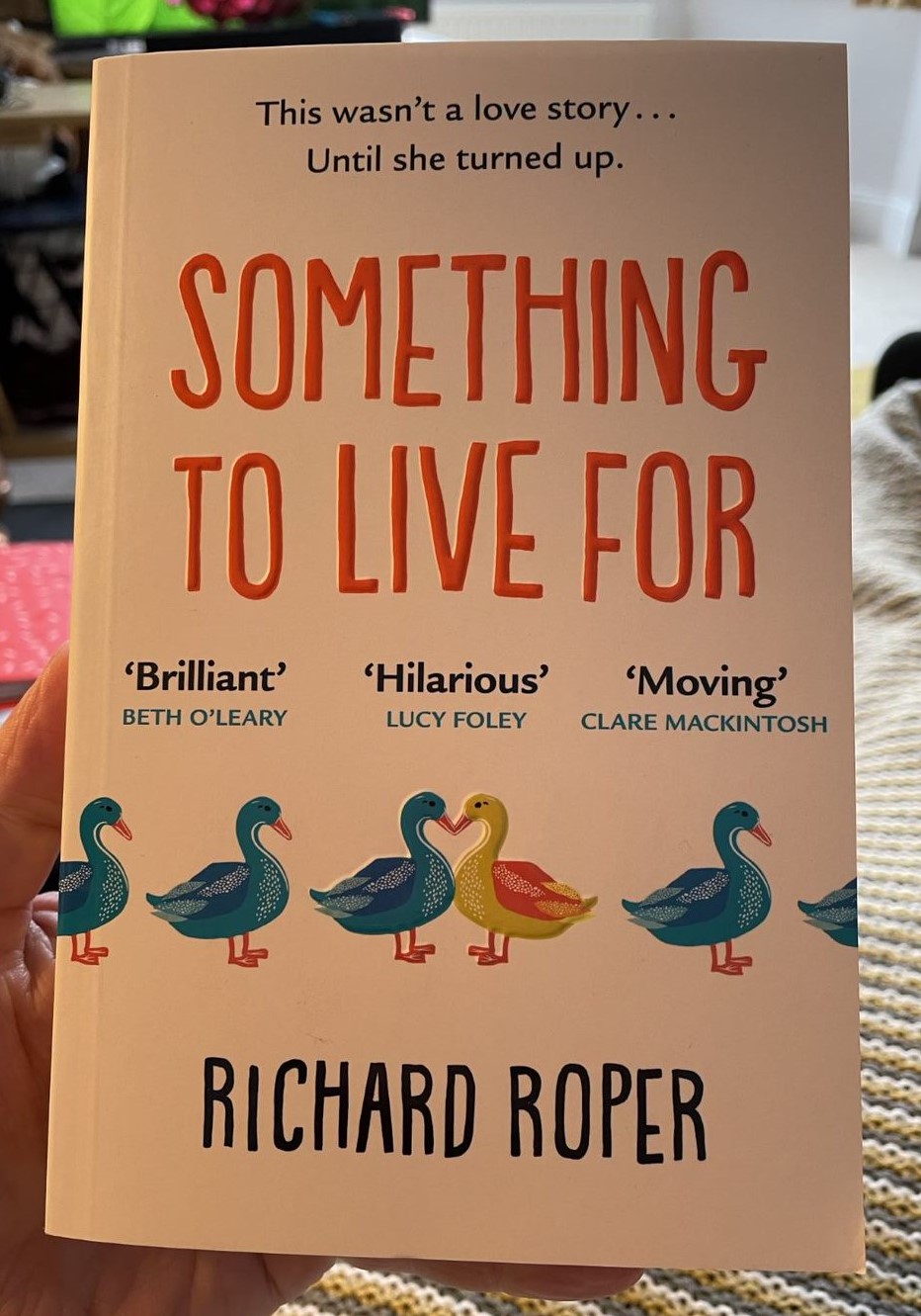
I first saw this book as an ARC on NetGalley, but it was in the middle of Covid-madness and I just didn’t have the time to read it. I was annoyed because I knew I would love it, so when I saw it in paperback recently at the supermarket, I had to pick it up.
And I was right, I loved it. At times hilarious, at times heart-breaking, it was amazingly written to draw me in and immediately love Andrew as a character.
He’s a bit of a strange guy – he works for the department of the council that deals with funerals for people who die with no family around. His job involves going into the houses of the deceased to try and find any details about potential family members and also to find out if there might be enough money to pay for the funeral. I’d never even considered that this would be a job, but I suppose someone has to do it…
To his colleagues, Andrew seems to have the perfect life at home – a wife and two kids and a lovely house to go back to at the end of the day. But what they don’t know is that this is all a lie, and at the end of the day Andrew goes home alone to his slightly depressing flat.
Andrew seems happy with this situation. Or at least, he thought he was, until Peggy arrives in his department and it seems like Andrew can’t keep up the facade forever. What he has to figure out though, is whether he wants to. And what might happen if he comes clean…
I thought I had this book pinned and I knew how it was going to end, but without giving any detailed spoilers, there was a plot twist that made me gasp with shock. I feel like that might be giving too much away, but I need to talk to someone about this book and I don’t have anyone!
I devoured this book in one day, I just loved the characters and the storyline so much and I felt completely invested in knowing how Andrew’s life would turn out. Laugh out loud funny, but also bringing tears to my eyes at times, it was a fantastic book to curl up with on a rainy Saturday afternoon.
I’m just sad I left it so long before I read it.
Louise Douglas
(I've got no) Shelf Control…
 Louise Douglas